


Food shelf life is not determined by preservatives alone.
For canned foods, flexible packaging, wet pet food, ready-to-eat rice, sauces, and some beverages, the thermal treatment applied after sealing can also have an important influence on storage stability. For food manufacturers, this means there are different technical approaches to shelf-life management rather than relying entirely on preservatives.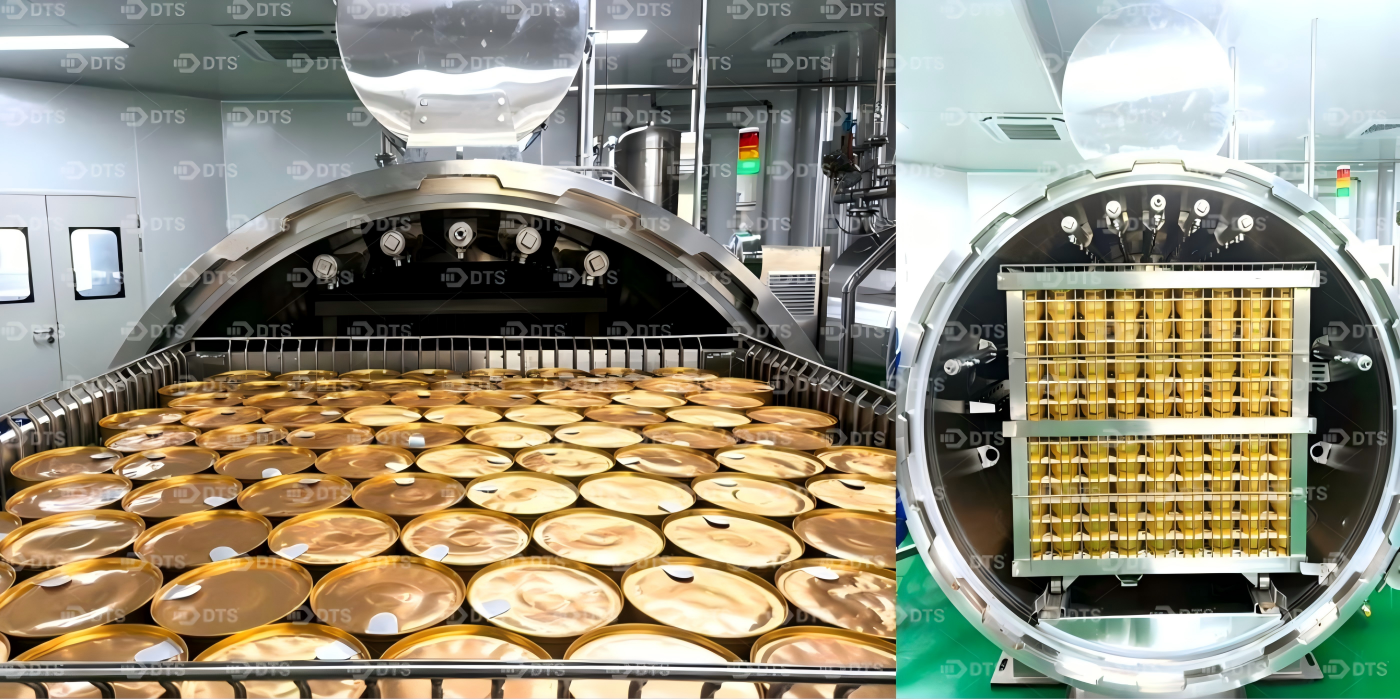
From “What to Add” to “How to Process”
Preservatives mainly work by inhibiting or slowing microbial growth. Thermal processing takes a different approach. Under controlled temperature, time, and pressure conditions, heat treatment can reduce the microbial load in a sealed product.
This approach is particularly relevant to foods intended for ambient storage and distribution over longer distances.
However, thermal processing is not simply about heating food to a higher temperature. Excessive temperature or processing time may affect the color, flavor, and texture of a product, while insufficient processing may not provide the intended level of microbial reduction.
For this reason, food manufacturers need to consider whether heat can reach the product evenly and sufficiently, and whether the heating and cooling stages are properly controlled.
Different products require different considerations.
The heat transfer characteristics of liquid foods differ from those of high-viscosity sauces. Packaging formats such as flexible pouches, cans, and PP bowls can also influence the thermal process. Product formulation, fill weight, package dimensions, and packaging materials are all factors that may need to be considered when developing a retort process.
This is why foods described as undergoing “high-temperature sterilization” do not necessarily require the same processing schedule.
Shelf Life and Product Quality Need to Be Considered Together
For food manufacturers, an appropriate shelf life is not simply about making the storage period as long as possible.
A more practical goal is to maintain product stability throughout the intended storage period while retaining the desired flavor, texture, and appearance as far as reasonably possible.
When developing a thermal process, manufacturers generally need to conduct heat penetration studies based on the characteristics of the product and package. Processing temperature, time, and cooling conditions can then be adjusted according to the relevant data.
Parameters such as the F₀ value can be used as part of thermal process validation and process management. The final processing conditions, however, still need to be evaluated according to the specific product.
This approach also provides a broader way of looking at food shelf life:
Shelf life is not simply created by adding a particular ingredient. It is influenced by the combined effects of product formulation, packaging, thermal processing, and storage conditions.
As Production Scales Up, Consistent Execution Also Matters
Once the thermal process has been established, another practical question is how to carry out the production process in a consistent way from batch to batch.
In larger production facilities, operations such as basket loading, product handling, retort loading, and unloading can involve a considerable amount of repetitive manual work. Differences in handling methods and operating pace may also affect the overall production flow.
This is where automatic conveying systems, robotic manipulators, RGVs, and automatic retort loading and unloading systems can become part of the production process.
Automation can help manufacturers carry out established production procedures in a more consistent manner while reducing some repetitive manual handling.
Ultimately, It Comes Back to the Consumer
Consumers usually do not see how food is thermally processed at the factory, nor do they pay much attention to whether products are moved manually or by automated equipment.
What matters to them is more straightforward: whether the product is convenient to store, whether it retains its expected characteristics after opening, whether the stated shelf life fits their needs, and whether the formulation matches their preferences.
Therefore, extending food shelf life does not have to rely on preservatives alone.
For foods suitable for thermal processing, an appropriate retort process can be an important part of shelf-life management. As production volumes increase, automation can help manufacturers apply established production procedures more consistently while connecting handling, loading, processing, and unloading operations.
From formulation and packaging to thermal processing and production management, food shelf life is ultimately influenced by the production system as a whole.
Post time: Sep-09-2026