


Moving from a standalone retort to an automated food sterilization line involves more than adding equipment. The key is to improve how products and sterilization baskets move between loading, retort processing and unloading. Conveyor systems, industrial robots and RGVs can work together to create a more coordinated production workflow.
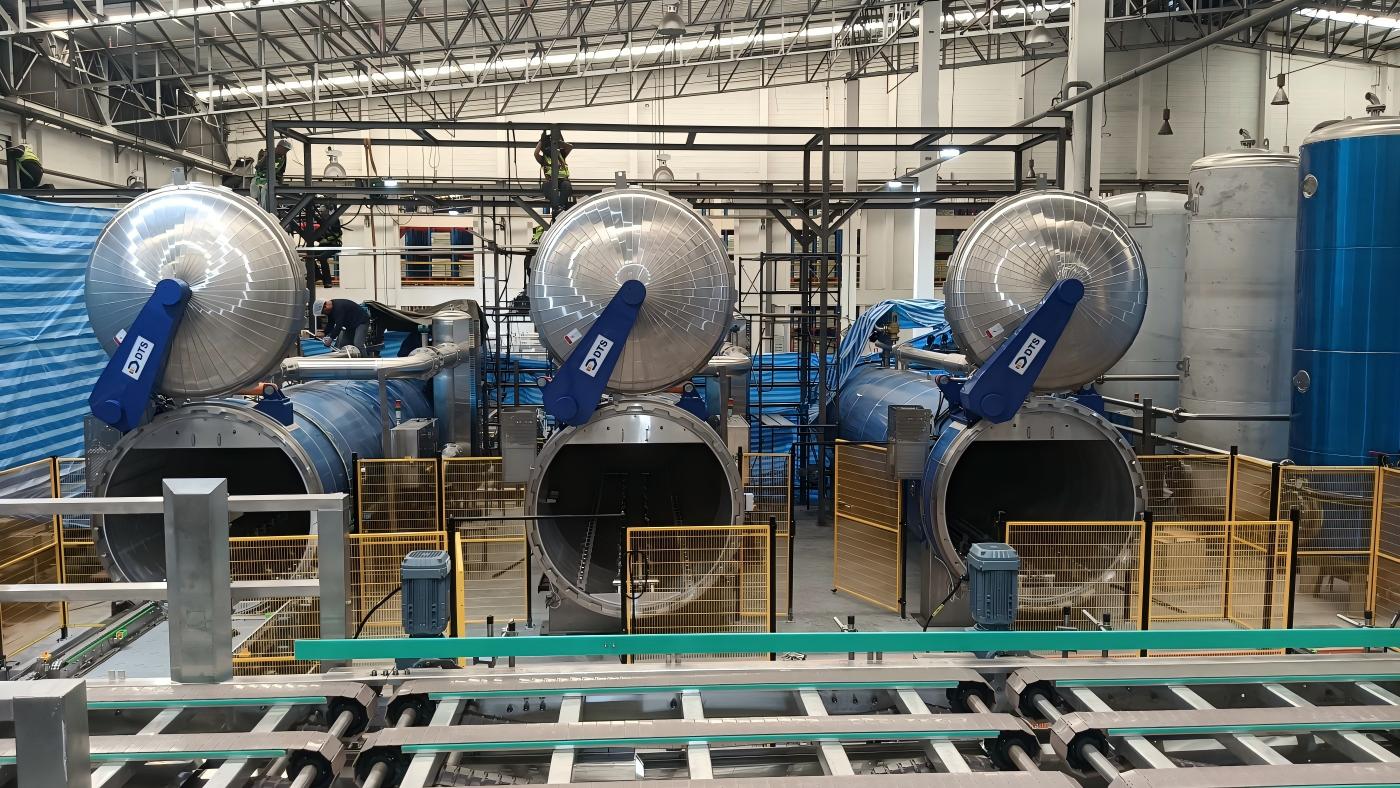
Connecting Each Stage of Production
In a standalone retort setup, workers may need to load products into baskets, move the baskets, position them inside the retort and unload them after sterilization. As production volumes increase, repeated handling and waiting between operations can require additional labor and affect production flow.
An automated retort line connects these operations through coordinated material handling equipment.
First, a conveyor system delivers products or terilization baskets to the designated workstation. A robot arranges the products and loads them into the baskets according to the required pattern. The RGV (Rail Guided Vehicle) then transfers the loaded baskets to the assigned retort.
After the sterilization cycle, the RGV moves the baskets to the unloading area. Robots and conveyors handle the next steps, transferring the products to downstream processing or packaging equipment.
Each component has a distinct function: conveyors link workstations, robots handle product loading and unloading, and RGVs transport baskets between stations. A central control system coordinates equipment movements and transfer signals to keep the process running in the correct sequence.
Automation Is About More Than Reducing Manual Labor
When these systems operate together, manufacturers can reduce repetitive handling tasks, lower their dependence on manual basket transfer and establish a more consistent material flow.
In plants with multiple industrial retorts, an RGV system can transfer baskets according to retort availability and the production schedule. With appropriate buffer capacity and cycle-time planning, the system can also help reduce interruptions caused by equipment waiting or poorly coordinated transfers.
However, adding automation equipment does not automatically increase total production capacity. If robot loading speed, transfer capacity and retort cycle times are not properly matched, faster performance at one workstation may not translate into higher overall throughput.
For this reason, an automated retort system should be designed around the actual production requirements, including product packaging, basket loading patterns, target output, sterilization cycles and available floor space.
From Equipment Upgrades to Production Flow Optimization
Upgrading from a standalone retort to an automated production line is fundamentally about connecting separate operations into a coordinated process.
Depending on the existing production bottlenecks, manufacturers can introduce automation in stages while retaining retorts that remain suitable for continued use. Improvements to basket handling, transfer routes and workstation coordination can help build a more integrated system without requiring every piece of equipment to be replaced at once.
Effective automation is not about installing as many machines as possible. It is about reducing unnecessary handling and waiting, coordinating equipment capacity and creating a production system that can adapt to future changes in output requirements.
Post time: Oct-09-2026