


When selecting a retort for food production, it is easy to focus on capacity first. A larger retort can process more products in one batch, but that does not always mean it is the right choice for every production line.
For food manufacturers, the more useful question is not simply “How large should the retort be?” but “How well does the retort capacity match the product, packaging and production plan?”
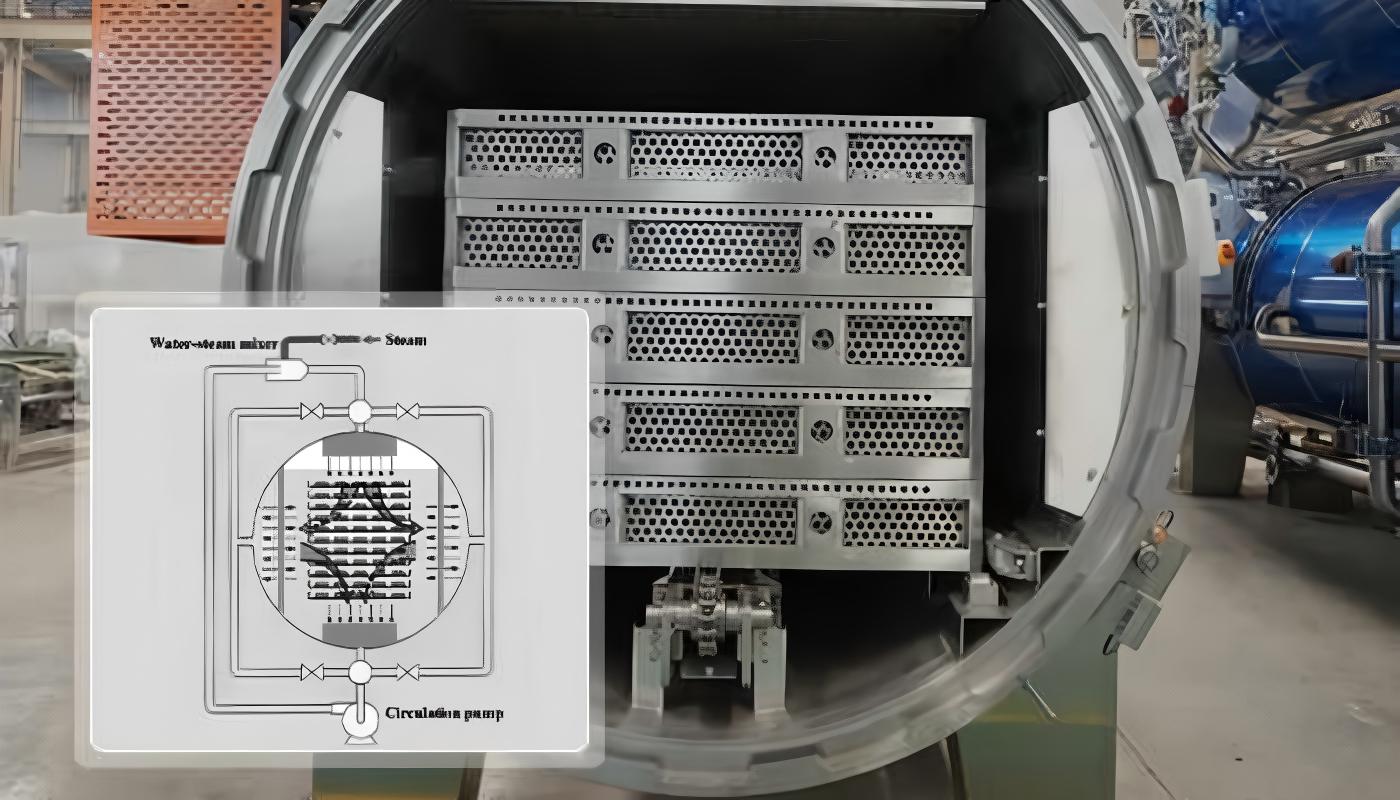
A suitable retort should provide enough loading space without creating unnecessary unused capacity.
A Larger Retort Does Not Always Mean Higher Output
Retort capacity is usually expressed by the size of the vessel or its rated batch volume. However, the rated capacity is not necessarily the same as the amount of finished product that can be processed in one batch.
Actual loading depends on the product, package dimensions, basket or tray arrangement, and the space required for proper heat circulation.
|
Retort Capacity |
Actual Loading Situation |
Possible Production Effect |
| Too small | High loading rate but more batches are required | May increase the number of processing cycles |
| Well matched | Good use of basket or tray space | Better suited to the planned production schedule |
| Too large | Low loading rate | Part of the available capacity may remain unused |
For example, a manufacturer producing a relatively small quantity of pouch-packed curry may not benefit from installing a very large retort if the daily production volume does not require it.
The equipment should be evaluated together with the batch size, processing time, loading efficiency and daily production target.
Product and Packaging Come Before Retort Capacity
The same retort can have very different practical loading capacities depending on the package being processed.
A pouch, can, glass bottle and PP bowl all require different loading arrangements. Package dimensions also affect how many units can be placed in a basket and how heat can move around the products.
A simple way to look at retort selection is:
Product → Packaging → Loading Arrangement → Actual Batch Load → Retort Capacity
This sequence is often more useful than selecting a retort based only on its nominal volume.
Packaging format can change the loading calculation
|
Product |
Typical Packaging |
Factors Affecting Loading |
| Ready-to-eat rice | Retort pouch | Pouch dimensions, fill weight, thickness and stacking |
| Curry or prepared meals | PP bowl | Bowl diameter, height, filling weight and tray arrangement |
| Wet pet food | Can | Can diameter, height and basket configuration |
| Sauce | Glass bottle or pouch | Package dimensions, fill volume and spacing |
For example, two pouches may contain 200 g and 400 g of the same food, but their dimensions and thickness may be different. This can change both the number of packages loaded per basket and the way heat moves through the product.
This is why package size and fill weight should be considered before determining the practical retort capacity.
Product Size Also Affects Thermal Processing
Retort selection is not only about how many packages can fit into the vessel.
The dimensions and composition of the food can affect heat penetration. A thick product, a dense food or a larger package may take longer to heat at the cold spot than a smaller or thinner package.
For products such as:
- · Ready-to-eat rice
- · Meat and poultry products
- · Seafood
- · Thick sauces and gravies
- · Wet pet food
- · Beans and other dense foods
the relationship between product size, package dimensions and heat penetration needs to be considered during process development.
A useful way to think about it is:
Capacity answers “How much can be loaded?”
Heat penetration answers “How does the product heat?”
Both questions matter when selecting and configuring a retort system.
The Real Production Capacity Is More Than Retort Volume
A retort may have a large rated capacity, but the actual output of a production line depends on several factors.
These can include:
- · Product loading per batch
- · Number of baskets or trays
- · Loading and unloading time
- · Heating and holding time
- · Cooling time
- · Product changeover
- · Daily operating hours
- · Number of retorts in the system
For this reason, comparing equipment only by vessel volume may not give a complete picture of production capacity.
For example, if a retort can process a large batch but requires a long cycle time, its actual daily output may not be significantly higher than a smaller retort running more efficiently with a suitable loading plan.
Think About the Production Schedule
Suppose a factory needs to process 1,000 kg of food per day.
The important question is not simply whether one retort can hold a large amount of product. The production plan should also consider how many kilograms can be processed in one batch and how many complete cycles can be completed during the working day.
A simplified production relationship is:
Daily Output ≈ Actual Batch Load × Number of Completed Batches
The actual result will also depend on the complete retort cycle, including loading, heating, holding, cooling and unloading.
This is why retort capacity should be evaluated together with the expected production schedule rather than as an isolated specification.
What About Future Production Growth?
Future production should also be considered when choosing equipment.
If production is expected to increase, a slightly larger retort or a system that can be expanded may make sense. However, simply choosing the largest available vessel is not necessarily the most practical solution.
A better approach is to consider:
- · Current production volume
- · Expected future demand
- · Product range
- · Package formats
- · Batch size
- · Available factory space
- · Loading and unloading method
- · Number of retorts required
- · Possibility of future automation
This can help avoid two common situations: equipment that is too small for the production plan, or equipment that remains underutilized for a large part of its operating time.
Retort Selection Should Start With the Product
For a new food product or a new production line, retort selection can be considered step by step:
Product Specification
↓
Package Size & Fill Weight
↓
Loading Arrangement
↓
Actual Batch Capacity
↓
Thermal Processing Cycle
↓
Daily Production Requirement
↓
Retort Selection
This approach connects the equipment with the actual manufacturing process.
For products still under development, small-scale testing can also help determine how the food and packaging behave during heating and cooling before moving to commercial-scale production.
Capacity Is Not the Goal — The Right Match Is
A larger retort can be useful when production volume requires it. But for many food manufacturers, the better choice is not necessarily the largest machine.
The more important considerations are whether the retort:
- · Matches the product and package dimensions
- · Provides suitable loading efficiency
- · Supports the required batch size
- · Fits the production schedule
- · Allows appropriate heat penetration and process development
- · Leaves reasonable room for future production growth
In other words, retort capacity should follow the production requirement, not the other way around.
For food manufacturers planning a new retort system, looking at the complete relationship between product, packaging, loading arrangement, thermal process and production volume can provide a more practical basis for equipment selection.
Post time: Sep-15-2026