


Rotary Steam Retort: Designed for Every Can of Classic Baked Beans

The Quality of Baked Beans Starts with Sterilization
Baked Beans have been a classic on European and American dining tables for over a century — a spoonful on breakfast toast, a can enjoyed during camping trips, carrying simple yet rich memories of beans with a full-bodied flavor.
However, few people realize that behind this “simple and delicious” food lies one of the most challenging processes in food production:sterilization.
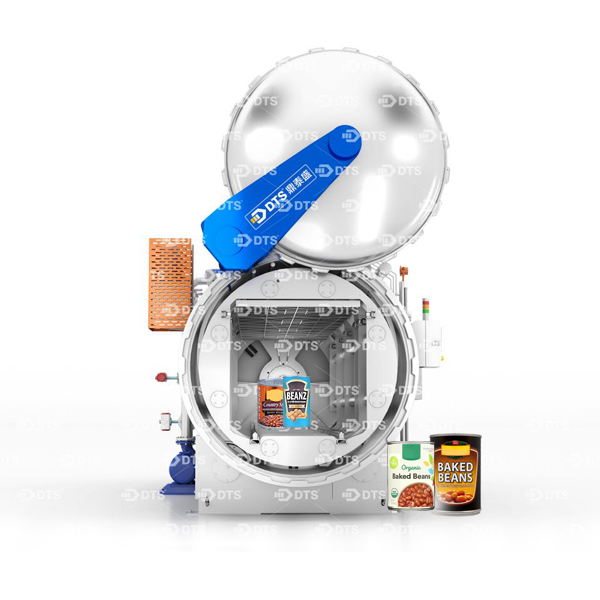
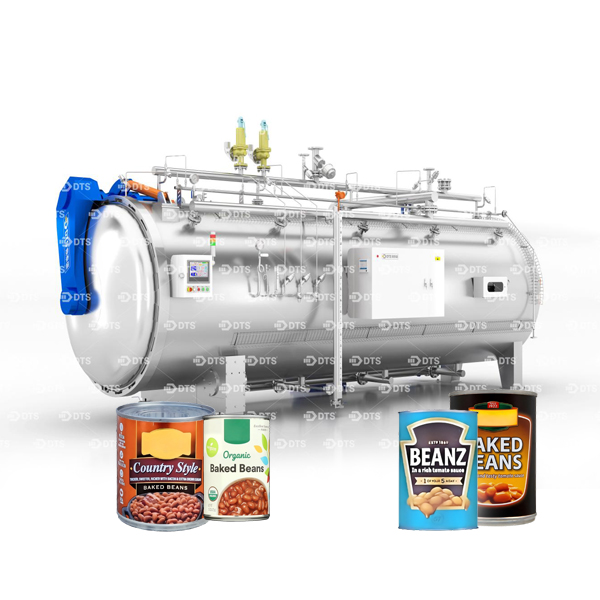

Baked Beans are a typical solid-liquid mixed product: plump beans combined with thick tomato sauce, sealed inside tin cans. This structure places much higher demands on sterilization equipment compared with ordinary soups or beverages.
A rotary steam retort is precisely the solution designed for this type of product.
Rotary Steam Retort Solves Three Major Challenges of Baked Beans
Challenge 1: Thick Sauce Makes Heat Penetration Difficult
Baked Beans contain highly viscous sauce. Natural convection inside the can is limited, making it difficult for heat to reach the center of the product evenly.
How a rotary retort solves it:
During sterilization, the cans continuously rotate , driving the beans and sauce to move and mix continuously. This creates a constant “stirring and heating” effect inside the can, significantly improving heat penetration and allowing the cold spot temperature to reach the required level faster.
Challenge 2: Uneven Heating Affects Product Quality
During static sterilization, beans near the can wall may become overcooked, soft, or even split, while the center of the can only just reaches the required sterilization temperature. This leads to inconsistent product quality.
How a rotary retort solves it:
Continuous rotation allows the contents to tumble evenly, making the heating curve of the entire can more consistent. The temperature difference between the can wall and the center is greatly reduced.
As a result, beans remain whole, firm, and visually appealing, while the sauce stays evenly distributed with a rich and stable texture — ensuring a high-quality product when the can is opened.
Challenge 3: Long Sterilization Time Increases Costs
To ensure complete sterilization at the center of the can, static sterilization often requires a longer heating cycle, increasing energy consumption and reducing production efficiency.
How a rotary retort solves it:
Improved heat penetration efficiency means the required F₀ value (sterilization intensity) can be achieved in a shorter time. Shorter sterilization cycles reduce steam and water consumption while increasing production capacity — delivering real cost advantages for large-scale manufacturing.
Faster Sterilization + More Uniform Heat Distribution + Better Bean Texture + Lower Energy Consumption
A rotary retort is not just an option — it is an ideal solution for solid-liquid mixed, low-acid canned foods such as baked beans.
Are you using a rotary retort for your baked beans production?



- English
- French
- German
- Portuguese
- Spanish
- Russian
- Japanese
- Korean
- Arabic
- Irish
- Greek
- Turkish
- Italian
- Danish
- Romanian
- Indonesian
- Czech
- Afrikaans
- Swedish
- Polish
- Basque
- Catalan
- Esperanto
- Hindi
- Lao
- Albanian
- Amharic
- Armenian
- Azerbaijani
- Belarusian
- Bengali
- Bosnian
- Bulgarian
- Cebuano
- Chichewa
- Corsican
- Croatian
- Dutch
- Estonian
- Filipino
- Finnish
- Frisian
- Galician
- Georgian
- Gujarati
- Haitian
- Hausa
- Hawaiian
- Hebrew
- Hmong
- Hungarian
- Icelandic
- Igbo
- Javanese
- Kannada
- Kazakh
- Khmer
- Kurdish
- Kyrgyz
- Latin
- Latvian
- Lithuanian
- Luxembou..
- Macedonian
- Malagasy
- Malay
- Malayalam
- Maltese
- Maori
- Marathi
- Mongolian
- Burmese
- Nepali
- Norwegian
- Pashto
- Persian
- Punjabi
- Serbian
- Sesotho
- Sinhala
- Slovak
- Slovenian
- Somali
- Samoan
- Scots Gaelic
- Shona
- Sindhi
- Sundanese
- Swahili
- Tajik
- Tamil
- Telugu
- Thai
- Ukrainian
- Urdu
- Uzbek
- Vietnamese
- Welsh
- Xhosa
- Yiddish
- Yoruba
- Zulu
- Kinyarwanda
- Tatar
- Oriya
- Turkmen
- Uyghur