


Canned Cheese Sauce Sterilization: Water Spray Rotary Retort

Sterilizing canned cheese sauce is not simply a matter of reaching a specific temperature. The real challenge is getting heat into a high-viscosity product evenly and consistently.
Cheese sauce typically contains cheese, dairy fat, proteins, emulsifiers, and other ingredients. Its relatively high viscosity and limited flow can make heat transfer more difficult. During conventional static thermal processing, heat moves gradually from the outside of the can toward the center. Because the product inside the can has limited movement, the center can become the critical point for heat penetration.
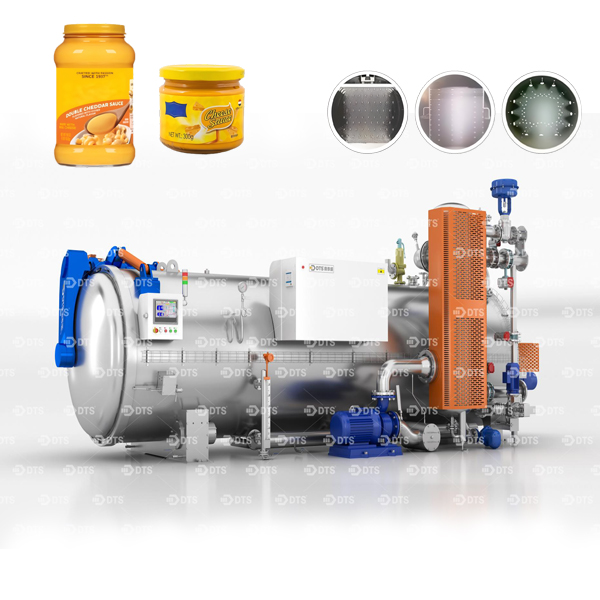
For cheese sauce manufacturers, simply increasing the sterilization temperature or extending the holding time is not always the best solution. A higher thermal load may affect the sauce’s color, texture, flavor, and emulsion stability.
The key to canned cheese sauce sterilization is therefore to find the right balance between food safety and product quality. This is where rotary retort technology can offer a practical alternative for high-viscosity products.
Water Spray and Rotary Technology for Cheese Sauce Processing
A Water Spray Rotary Retort combines water spray heating with controlled rotation of the product.
During sterilization, process water is circulated through the retort and distributed evenly over the cans through the spray system. This creates a stable and uniform heating environment around the product.
At the same time, the retort basket rotates the cans at a controlled speed. The movement of the cans causes the cheese sauce inside to move to some extent, which can help improve heat transfer within the product.
The advantage is not simply adding more heat. Instead, the process focuses on how heat moves from the package into the center of the product.
For viscous products such as cheese sauce, cheese dips, cream sauces and other thick foods, controlled rotation can promote internal product movement and improve heat transfer. Combined with uniform water spray, it provides a more consistent thermal environment throughout the retort process.
For this reason, Water Spray Rotary Retorts are well suited to canned food applications where heat penetration, product quality and batch-to-batch consistency are important.
From Reaching the Temperature to Controlling the Entire Process
The thermal processing of canned cheese sauce cannot be determined by temperature and holding time alone.
Different formulations can have very different viscosities, solids content and fat levels. Can size, fill weight and headspace can also affect heat penetration. As a result, the same sterilization temperature may produce different heating curves for different products.
In actual production, heat distribution and heat penetration tests should be carried out for the specific product and package. The cold spot can then be identified, and process parameters can be established based on actual test data, including the target F₀ value where applicable.
Sterilization temperature, holding time, rotation speed, pressure and cooling conditions should all be determined through product-specific process validation rather than simply copying a standard recipe.
A water spray rotary retort can automatically manage key parameters such as temperature, pressure, circulating water and rotation. This helps maintain consistent processing conditions from batch to batch.
For canned cheese sauce manufacturers, a stable and repeatable thermal process can help meet food safety requirements while maintaining better control over product quality.
From a Retort to a Complete Canned Cheese Sauce Production Line
A water spray rotary retort can also be integrated with upstream and downstream equipment to create a more complete automated production process.
After formulation, mixing, heating and homogenization, the cheese sauce is filled into cans and sealed. The sealed cans are then transferred to the retort area for loading, sterilization and cooling.
Depending on production capacity, the system can be configured with automatic loading, retorting, cooling, unloading and conveying equipment.
A typical production flow is:
Cheese Sauce Preparation → Heating / Homogenization → Filling → Can Seaming → Conveying → Retort Loading → Water Spray Rotary Sterilization → Cooling → Unloading → Conveying → Inspection → Packaging
For food manufacturers handling high production volumes, this type of integrated system can reduce manual handling, improve production efficiency and make the sterilization process more consistent.
In addition to canned cheese sauce, water spray rotary retorts can be considered for products such as cheese dips, cheese-based sauces, cream sauces, pasta sauces, meat sauces, thick soups and other high-viscosity foods.
The final equipment configuration and thermal process should be designed according to the product formulation, container size, fill weight, loading pattern and required thermal process.
DTS Water Spray Rotary Retort for Canned Cheese Sauce
For canned cheese sauce, the right sterilization equipment needs to do more than provide high-temperature processing. It also needs to address practical production challenges such as heat penetration, temperature uniformity and product quality.
The DTS Water Spray Rotary Retort combines circulating water spray with controlled rotation to provide a stable thermal processing environment for canned cheese sauce.
The water spray system provides uniform heat transfer around the cans, while the rotary system promotes product movement inside the container. The automatic control system manages the key processing parameters throughout the sterilization cycle.
The goal is not simply to “heat the product.” It is to develop a validated and repeatable thermal process that balances food safety, heat penetration, product quality and production efficiency.
For food processors looking for Canned Cheese Sauce Sterilization Equipment, Water Spray Rotary Retorts or Rotary Retort Machines, this technology provides a practical option for industrial canned cheese sauce production.



- English
- French
- German
- Portuguese
- Spanish
- Russian
- Japanese
- Korean
- Arabic
- Irish
- Greek
- Turkish
- Italian
- Danish
- Romanian
- Indonesian
- Czech
- Afrikaans
- Swedish
- Polish
- Basque
- Catalan
- Esperanto
- Hindi
- Lao
- Albanian
- Amharic
- Armenian
- Azerbaijani
- Belarusian
- Bengali
- Bosnian
- Bulgarian
- Cebuano
- Chichewa
- Corsican
- Croatian
- Dutch
- Estonian
- Filipino
- Finnish
- Frisian
- Galician
- Georgian
- Gujarati
- Haitian
- Hausa
- Hawaiian
- Hebrew
- Hmong
- Hungarian
- Icelandic
- Igbo
- Javanese
- Kannada
- Kazakh
- Khmer
- Kurdish
- Kyrgyz
- Latin
- Latvian
- Lithuanian
- Luxembou..
- Macedonian
- Malagasy
- Malay
- Malayalam
- Maltese
- Maori
- Marathi
- Mongolian
- Burmese
- Nepali
- Norwegian
- Pashto
- Persian
- Punjabi
- Serbian
- Sesotho
- Sinhala
- Slovak
- Slovenian
- Somali
- Samoan
- Scots Gaelic
- Shona
- Sindhi
- Sundanese
- Swahili
- Tajik
- Tamil
- Telugu
- Thai
- Ukrainian
- Urdu
- Uzbek
- Vietnamese
- Welsh
- Xhosa
- Yiddish
- Yoruba
- Zulu
- Kinyarwanda
- Tatar
- Oriya
- Turkmen
- Uyghur